Booster Robots focused on lowering the barrier to entry for Embodied AI research and education. These robots are distinguished by their robust, lightweight design, high joint agility (up to 23 Degrees of Freedom (DoF)), and their open-source software ecosystem. They are designed to withstand falls and high-intensity use, making them ideal platforms for university labs, RoboCup competitions (where Booster robots have a strong championship pedigree), and developers exploring complex bipedal locomotion, grasping, and human-robot interaction.
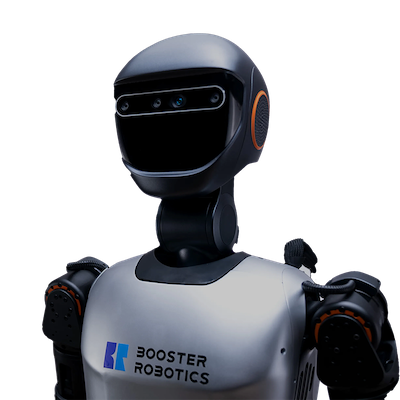
A: The primary market is scientific research, higher education. Booster aims to provide an affordable, high-performance platform to accelerate the development of Embodied AI and complex bipedal locomotion algorithms globally.
A: The biggest advantage is the combination of high performance (e.g., up to 200 TOPS AI computing and high joint torque) with a relatively low cost and a completely open-source ecosystem. This makes advanced humanoid research accessible to a wider range of institutions.
A: Yes. The Booster platform is highly open, providing a comprehensive SDK and full compatibility with industry standards including ROS (Robot Operating System) and ROS2. They also integrate with advanced simulation environments like NVIDIA Isaac Sim for reliable sim-to-real transfer.
A: The Booster T1 is the larger, more powerful platform (approx. 118cm tall, higher torque/autonomy) designed for advanced research and competitions like the AdultSize RoboCup league. The Booster K1 is a compact, entry-level platform (approx. 95cm tall) designed for education, smaller-scale R&D, and the KidSize RoboCup league, prioritizing portability and cost-effectiveness.
A: Yes. The platform is specifically designed to support advanced learning techniques like Reinforcement Learning (RL) and Imitation Learning (IL). Its onboard AI computing power and open frameworks allow researchers to train the robot to learn and replicate complex human-like movements and dynamic tasks.
Uno Family is multi-functional and comprehensive intelligent AGV-based indoor robot type that comprehensively adopts technologies such as artificial intelligence, Internet of Things, cloud computing and big data, and has the ability of autonomous perception, autonomous walking, autonomous obstacle avoidance, autonomous identification, automatic detection, Facilities management via artificial intelligence video analysis (VA) etc., which promotes the upgrading of a variety of intelligent services and reduces the operating costs of services.
Uno Indoor Patrol Robot is designed for navigation within indoor buildings. It possesses the capability to be programmed with a multi-layer map and integrate with elevators system to facilitate multi-floor patrolling. This robot is an ideal choice for patrolling a diverse range of environments, including schools, warehouses, shopping malls, hospitals, commercial, residential buildings, and offices. Moreover, it proves invaluable in exhibition and expo settings, where it aids in tour guide features, environment management, etc. Additionally, it can assist with issuing announcements, facilities management like the faulty light detection, garbage bin overflow detection, people fall down detection and more, ensuring comprehensive security measures. It is well-suited for patrolling schools, warehouses, shopping mall, hospitals, commercial/residential building and offices.
This patrol robot is a 5G-enabled autonomous patrol solution designed for high-security indoor and outdoor environments. Its core functionality includes scheduled patrols with automated phototaking, intelligent video analysis—such as unrecognized license plate recognition and early-stage fire detection—and instant alarm reporting to centralized command centers. Featuring IP66 weatherproofing and Lidar-SLAM navigation, it provides 24/7 surveillance with AI-driven anomaly detection. It is fully compatible with VMS (Video Management Systems) and AR-enhanced command centers for real-time digital twin integration.
A: The vehicle is an autonomous wheeled vehicle designed for persistent security patrol and surveillance across large outdoor and indoor flat areas, such as industrial parks, university campuses, hospitals, and commercial facility perimeters.
A: It acts as a force multiplier by providing 24/7 continuous presence and data logging. It can detect anomalies, unauthorized access, and environmental hazards (e.g. fire/smoke), freeing up human guards for immediate intervention tasks.
A: Yes, it is typically designed with robust casing and is rated for specific ingress protection (IP) levels, allowing it to operate autonomously in various weather conditions common in the Southeast Asian environment (e.g., rain, high humidity).
As the fruit of scientific and technological progress, the robot dog has not only achieved a leap in technology, but also demonstrated great potential in marketing and social impact. They are not only future explorers, smart assistants, safety pioneers, life partners, but also they are leading the innovation trend.
A: Its main applications are remote security patrol, asset inspection (e.g., chemical pipes, power lines), and autonomous mapping in complex industrial environments, especially those requiring climbing stairs or traversing rough, uneven terrain.
A: As a quadruped (four-legged) robot, it uses advanced dynamic locomotion algorithms to navigate stairs, slopes, gravel, and construction debris. This makes it ideal for high-risk or inaccessible areas like tunnels, power stations, and construction sites.
A: Yes. provides comprehensive Secondary Development Kits (SDKs) and APIs, making it a highly popular and cost-effective platform for university researchers and startups developing custom AI, vision, and navigation payloads.
The Kinova Gen3 is a premium collaborative robot (cobot) known for its 7 DoF dexterity and lightweight form factor. It offers exceptional flexibility for both advanced robotics research and diverse industrial applications. The Gen3 is designed for safe, direct human interaction and easy deployment in high-mix manufacturing. Its open ecosystem allows engineers and researchers to quickly integrate custom AI and vision systems, ensuring high precision and maximizing automation potential.
A: The Kinova Gen3 is primarily used for advanced robotics research, AI development, and high-mix, low-volume precision assembly in constrained industrial spaces, leveraging its high flexibility with 7 Degrees of Freedom (DoF).
A: Yes. The Gen3 features an open control architecture with native, full support for ROS (Robot Operating System) and ROS 2, making it the preferred platform for university and startup R&D teams.
A: The 7 DoF (seven degrees of freedom) allows the Gen3 arm to reach around obstacles, operate in dense workspaces, and perform complex path planning that standard 6 DoF arms cannot achieve. This is ideal for machine tending or inspection in cluttered work cells.
Our mission is to provide customers with solutions through innovative technologies to help them achieve more efficient and smarter production and life. With customer orientation, innovation, teamwork and continuous improvement as our core values, we are committed to creating a smarter and more efficient In the future, we will focus on the development of 5G, smart home, industrial automation, and medical devices. Therefore, in addition to robots and unmanned driving solutions, we also provide comprehensive solutions such as system integration, technical consulting, and after-sales service. We also provide customized software development and highly scalable and flexible services for our valued customers. solutions to ensure customer satisfaction.

Artificial intelligence (AI) solutions are advanced technologies that use algorithms, data analysis, and computational power to automate processes, make predictions, and learn from data without explicit programming.

Operators can instantly view the status of all robotic equipment at a glance, ensuring quick assessments and informed decision-making
Teksbotics developed catered solutions tackling specific needs. For example, studying the ecosystems of birds, pest control via monitoring mosquitoes' pattern , fire detection and fall detections.

AI model training is the process of feeding curated data to selected algorithms to help the system refine itself to produce accurate responses to queries. Many different types of AI algorithms are available; the correct one for a project depends on scope, budget, resources, and goals.
Teksbotics developed catered solutions tackling specific needs. For example, studying the ecosystems of birds, pest control via monitoring mosquitoes' pattern, fire detection and fall detections.
Contact us
Contact Our Hong Kong HQ: